









Research
先進複合材料は比強度・比剛性といった機械的特性において、従来の構造材料に比べはるかに優れているため、 多くの工業分野への適用が急速に広がっている。例えば現在開発中の次世代旅客機においてはCFRPを二次構造だけ でなく胴体や主翼といった主要構造へ適用することが計画されている。環境問題が契機となり、自動車への適用 拡大も予想される。また、宇宙分野においても、ロケットエンジンのノズルにCMCが、宇宙往還機においてはC/Cが 利用されている。このような傾向は、ここ数十年にわたり新素材として開発されてきた複合材料が構造材料として 十分に成熟しつつあるという背景がある。これに伴い、複合材料における研究課題も“いかにして作るか”から “いかにして使うか”という新しい段階を迎えつつある。
さて、複合材料の実構造への適用を考えるとき、古くから言われ、未だに重要な検討課題に“複合材料はいかに して壊れるのか”がある。金属やセラミックスといった均質材料に比べ複合材料の破壊プロセスは極めて多様である。 それゆえ、均質材料において確立された破壊力学・損傷力学の単なる転用では正当な評価が行えない。従って、 複合材料の損傷解析は均質材料と別個に、独自の変遷を経て発展してきた。
しかしながら、近年、この複合材料の損傷解析の分野における研究動向において大きく2つの傾向が顕著となって きた。1つには、実験事実に基づき、対象となる損傷を絞り込んだうえで、“微視的な損傷には破壊力学を、巨視的な 損傷には損傷力学を適用する”というアプローチが数多く見られるようになったことである。これは金属やセラミックス といった均質材料の破壊・損傷解析で活躍してきた研究者がその知識を複合材料の破壊・損傷解析に活かす環境が整備 されてきたということに他ならない。もう1つには、コンピューターの発展に伴い、複合材料内部の損傷を直接 シミュレート出来るようになってきたことである。このことは、従来、実験で断片的にしか見ることの出来なかった 損傷プロセスを、コンピューター上でより詳細に見ることを可能とし、複合材料関係者だけでなく、従来の構造材料に 慣れ親しんでいる設計・開発者にとって、“安心して複合材料を使うため”の重要な知見の提供につながっている。 また、コンピューター科学者が複合材料研究に本格参入する土壌が出来たともいえる。以上の2つの傾向は複合材料の 損傷解析がより学際的な分野として発展しうることを示唆している。
本研究室では、これらの背景に基づき、今後さらに航空宇宙分野での利用拡大が予想される繊維強化複合材料の 特に破壊と変形に焦点を絞り、日夜研究に取り組んでいる。
※最近の研究については、「材料・構造スマートシステム学分野の紹介」(2020年6月2日)をご覧ください。
※研究室での研究の進め方についてまとめた
リーフレット(第7版 2024年6月4日)です。本研究室への進学希望の
学生さんは是非参考にして下さい。
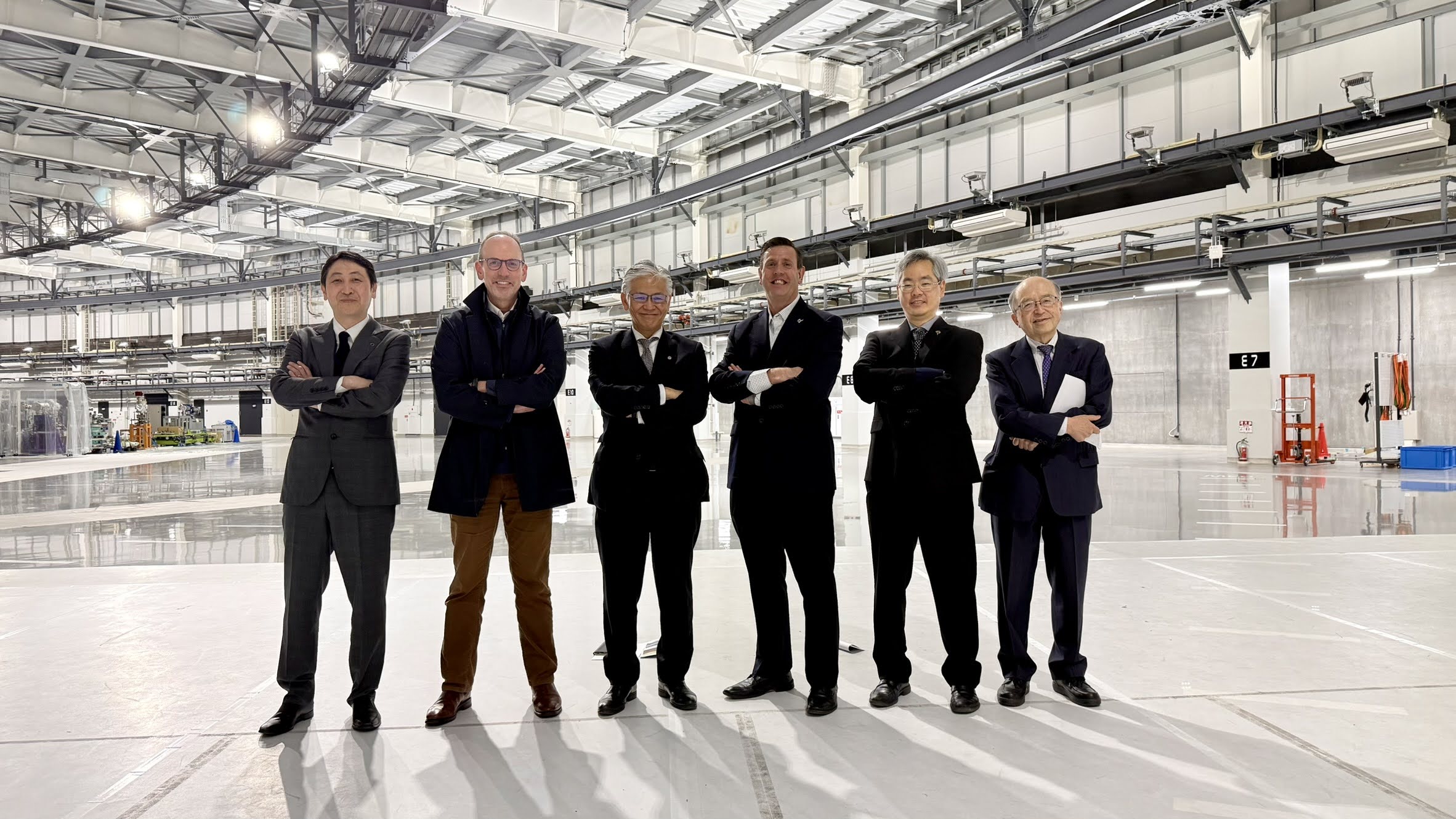
Boeing社のVice Presidentとの意見交換@NanoTerasu
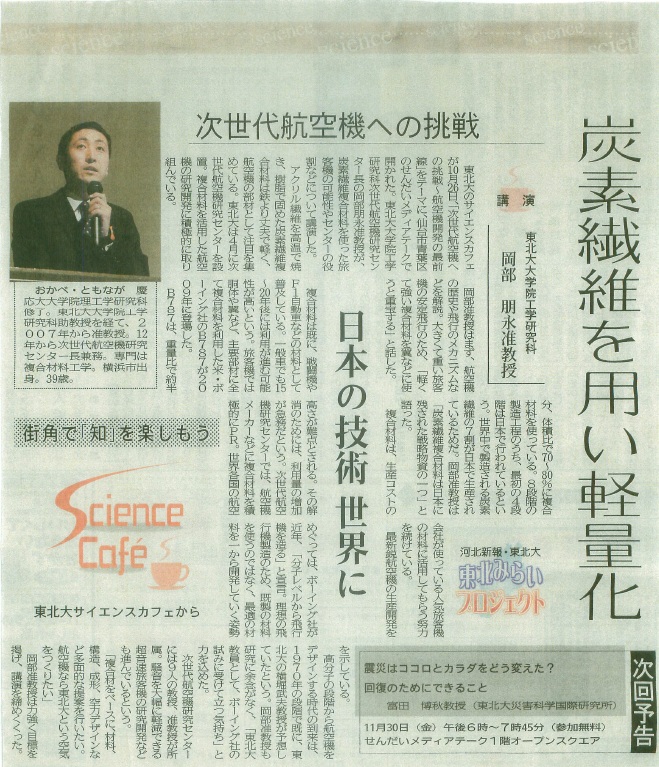
東北大学サイエンスカフェ「次世代航空機への挑戦 ~航空機開発の最前線~」
東北大学オープンキャンパス2020 岡部・白須・川越研究室紹介
コラム
知識多様体に関する研究
<知識多様体に関する研究>(2026年6月3日up)
知識多様体とは、たくさんの文書を「意味の位置関係」として並べた空間のことです。 たとえば、文書として学術論文を例に取ると各論文の本文をそのまま読む代わりに、まず文書を埋め込みベクトルやTF-IDFベクトルに変換します。 これは、文書に含まれる語句や表現の特徴を数値の列で表したものです。内容が似ている文書同士はベクトルも近くなり、異なる内容の文書は遠くなります。 この高次元の関係を2次元に写すと、論文同士の意味的な地図ができます。地図上の点は論文を表し、近い点ほど研究内容が近いと考えます。 さらに、点と点の間を補間すれば、既存論文の中間にある「仮想的な知識」も推定できます。 測地線は、その知識空間のゆがみを考慮した最短経路で、単なる直線ではなく、意味が自然に変化する道筋を表します。 例えば、ChatGPT PROにご自身で準備した20本の論文PDFと仕様書(2026_06_03_知識多様体解析仕様書.pdf)を渡し、実行を依頼すれば、解析が出来ます。 もしも、これを簡単に試してみたいときには、ご自身で準備した20本の論文PDFと仕様書(2026_06_03_プロンプト仕様書.pdf)に記されているプロンプトを順に打ち込んでください。簡易な解析が行えます。 また、本手法は、TF-IDFベクトルを L1 正規化し、語彙および n-gram 特徴量上の確率分布として扱えば、Fisher情報計量を導入できる情報幾何学的な拡張が可能になります(AI4S_知識多様体(ver.2).pdf)。 さらに、知識多様体を「意味軌道を管理する生成器」として利用すれば、LLMの長文生成を改善できる可能性があります。 たとえば、各段落を多様体上の点として射影し、段落列を意味軌道として管理します。 さらに、Fisher主方向や語彙分布を用いて次段落候補を評価・補正すれば、局所的な自然さと大域的なナラティブ整合性を両立し、LLMの弱点として考えられている、大域的な論理崩壊や結論のずれを抑えられます。 この仕組みはLLMに直接組み込むだけでなく、外付けの制御層として利用することも可能です。
詳細はこちらで:https://arxiv.org/abs/2606.05907
Youtubeでのデモ動画はこちらで:https://youtu.be/OlsZEvq9BTw
<Research on Knowledge Manifolds>(June 3rd, 2026 up)
A knowledge manifold is a space in which many documents are arranged according to their “semantic positional relationships.” Instead of reading the full text of each paper directly, each document is first converted into an embedding vector or a TF-IDF vector. This is a numerical representation of the features of the words and expressions contained in the document. Documents with similar content have vectors that are close to each other, while documents with different content are farther apart. By projecting these high-dimensional relationships into two dimensions, a semantic map of the papers can be created. Each point on the map represents a paper, and points that are closer together are considered to have more similar research content. Furthermore, by interpolating between points, it is possible to estimate “virtual knowledge” that lies between existing papers. A geodesic represents the shortest path that accounts for the distortion of this knowledge space; it is not merely a straight line, but a path along which meaning changes naturally. For example, if you provide ChatGPT Pro with 20 paper PDFs that you have prepared, together with the specification document “2026_06_03_Knowledge_Manifold_Analysis_Specification.pdf,” and ask it to perform the analysis, the knowledge manifold analysis can be carried out. If you would like to try a simpler version, prepare 20 paper PDFs and enter the prompts in sequence as described in “2026_06_03_Prompt_Specification_Document_EN.pdf” This will allow you to conduct a simplified analysis of the knowledge manifold. Please note that some adjustments may be needed when using them in languages other than Japanese. We recommend working with an LLM to tune them appropriately. The method can be extended from an information-geometric perspective by L1-normalizing TF-IDF vectors and interpreting them as probability distributions over vocabulary and n-gram features, thereby enabling the introduction of the Fisher information metric. Furthermore, if a knowledge manifold is used as a “generator that manages semantic trajectories,” it may improve long-form generation by LLMs. For example, each paragraph can be projected as a point on the manifold, and the sequence of paragraphs can be managed as a semantic trajectory. In addition, by using Fisher principal directions and vocabulary distributions to evaluate and revise candidate next paragraphs, it may be possible to balance local fluency with global narrative coherence, thereby reducing issues often regarded as weaknesses of LLMs, such as large-scale logical breakdowns and deviations in the conclusion. This mechanism can be directly integrated into an LLM, but it can also be used as an external control layer.
For more details, please see: https://arxiv.org/abs/2606.05907